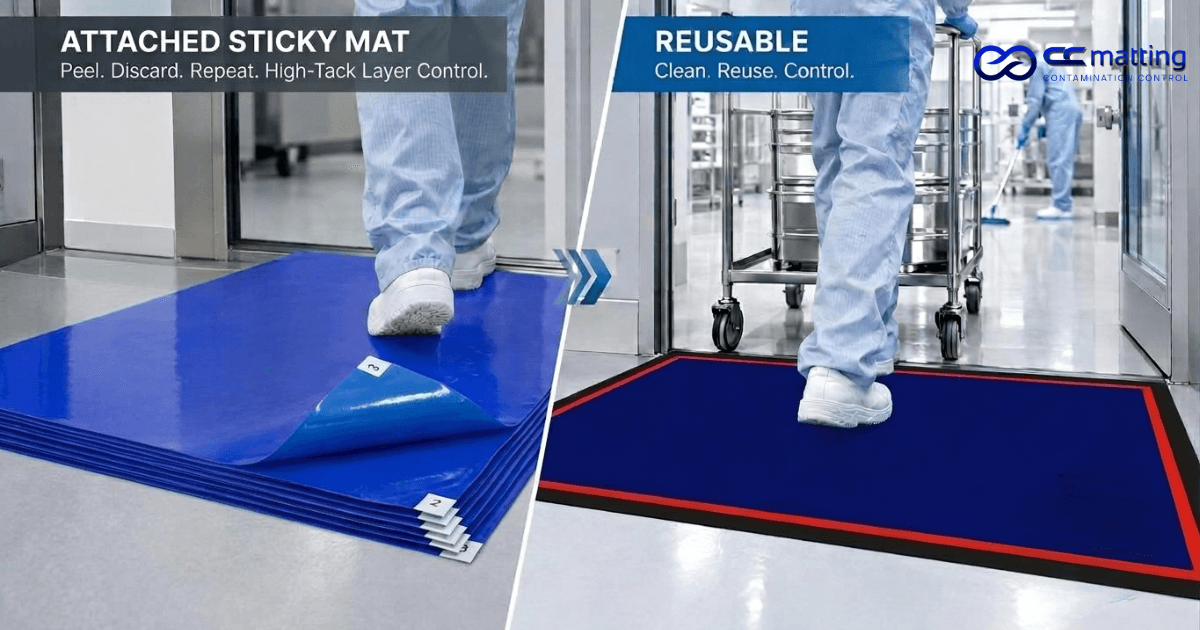
What does a sticky mat really add to your waste stream, and what does a sticky mat alternative change?
Twenty-three grams. That is roughly the polyethylene film in one standard 24 × 36 inch tacky mat sheet, before the adhesive coat. One sheet is trivial. Multiplied by every peel, at every doorway, every day, it becomes one of the few cleanroom waste streams that grows in direct proportion to how carefully a site follows its own procedures.
Sticky Mats vs Washable Cleanroom Mats at a Glance
- How contamination is held Single-use sticky mats: Adhesive film sheet Polymeric contamination control mats: Polymer surface, cleaned in place
- How the surface is renewed Single-use sticky mats: Top sheet peeled and discarded Polymeric contamination control mats: Routine cleaning according to site SOP
- Routine waste Single-use sticky mats: Used film, pad backing and packaging Polymeric contamination control mats: Wipes and cleaning solution
- Replacement interval Single-use sticky mats: Pads replaced as sheets run out Polymeric contamination control mats: Stated lifetime of 3–5 years (CC Matting TDS)
- Independent evidence Single-use sticky mats: Product-dependent; request supplier data Polymeric contamination control mats: Particle removal, ISO Class 5 particle emission and ESD reports (see below)
The Waste Maths: 4–8 Sheets per Doorway per Day For a busy gowning or material-transfer doorway peeling four to eight sheets a day, assume a 24 × 36 inch sheet (0.56 m²), 45 µm polyethylene film (within the 1.5–2 mil range typical of suppliers’ published specifications), a film density of 0.92 g/cm³ and 30 sheets per pad.
One Doorway: Annual Sticky Mat Use
- 4 sheets/day, 250 days
Film: 23 kg
Film area: 557 m²
Pads/year: 33
- 8 sheets/day, 250 days
Film: 46 kg
Film area: 1,115 m²
Pads/year: 67
- 4 sheets/day, 365 days
Film: 34 kg
Film area: 814 m²
Pads/year: 49
- 8 sheets/day, 365 days
Film: 67 kg
Film area: 1,628 m²
Pads/year: 97
At the upper end, one continuously operated doorway discards around 1,600 m² of film a year, roughly six doubles tennis courts. Ten such doorways send about 670 kg of film to waste annually.
These are floor figures, not ceilings. They exclude the adhesive, the pad backing, frames, cartons and inbound shipping.
Why diligence increases the waste
A site that peels at every shift change, or after each trolley movement, is doing the right thing for footwear contamination control. It is also generating more plastic, so contamination control and sustainability targets pull in opposite directions at the same threshold.
Where the film ends up
Soiled, adhesive-coated film is rarely accepted by conventional plastic recycling, so it usually goes to landfill or incineration, and in some pharmaceutical and healthcare areas it is handled as controlled waste.
What “Zero-Waste” Can Honestly Mean at a Doorway
Reusable contamination control matting does not make waste disappear. It changes its shape: a continuous daily stream becomes routine cleaning consumables plus one item at end of life.
For scale, CC Matting’s technical data sheet lists the heavy-duty material at 3.3 kg/m², so a 2 m² doorway mat is roughly 6.6 kg of material over a stated 3–5 year life. Over the same period, one doorway’s tacky film ranges from about 70 kg (four sheets a day, 250 days, three years) to about 340 kg (eight a day, continuous, five years). The product safety data sheet recommends recycling the mat where possible at end of life.
Reducing Waste Without Loosening Control
EU GMP Annex 1 requires a documented contamination control strategy (CCS). It does not prescribe a particular mat type, and no mat guarantees compliance on its own. Treat any change as a change-controlled decision:
• Set a baseline. Count the pads ordered per doorway per year from purchasing records.
• Match evidence to risk. Ask for particle removal data, particle emission data for the material and, where electronics are present, ESD data.
• Write the cleaning SOP first. Define agent, frequency and sign-off.
• Include wheels. Trolleys and carts are part of the load on cleanroom entrance mats, not an afterthought.
• Trend monitoring. Compare environmental monitoring data before and after the switch.
Where Contamination Control Polymeric Matting Fits
CC Matting’s polymeric contamination control mats have been independently tested. In a CPC Laboratories walk-off study using warehouse floor dirt, average removal from shoe soles after three steps was 91.8% for particles >5 µm, 100% for particles >100 µm and 92.0% for fibres >100 µm. For trolley wheels rolled across 90 cm of mat, the figures were 90.1%, 100% and 100%. Results apply only to the test conditions.
Separately, Fraunhofer IPA rated the material suitable for ISO Class 5 in a particle emission test under mechanical stress, and TUS Athlone measured its surface resistivity in the static dissipative range.
Frequently Asked Questions
How much plastic waste does one tacky mat pad produce?
A 30-sheet, 24 × 36 inch pad at 45 µm contains roughly 0.7 kg of polyethylene film, before adhesive, backing and packaging. Weight varies with sheet size and film thickness.
Can used sticky mat sheets be recycled?
Rarely. The adhesive coating and captured contamination usually exclude used sheets from conventional plastic recycling. Your waste contractor can confirm what is accepted locally.
Are washable contamination control mats suitable for ISO Class 5 areas?
It depends on the product’s evidence. Look for particle emission testing referenced to ISO 14644-1. CC Matting’s heavy-duty material holds a Fraunhofer IPA qualification for ISO Class 5; placement should still follow your contamination control strategy.
Does replacing tacky mats affect GMP compliance?
EU GMP Annex 1 does not mandate a specific mat type. Replacing one should be assessed under change control, supported by product evidence, a cleaning SOP and environmental monitoring.
How are polymeric contamination control mats cleaned?
Follow the supplier’s cleaning instructions and your site SOP. CC Matting’s efficacy testing used 70% isopropyl alcohol with lint-free wipes, and its safety data sheet advises avoiding acetones and abrasive agents.
Next Step
If you are building a waste baseline for your own doorways, the test certificates behind the figures above are on the CC Matting compliance page. Specifications for reusable contamination control matting are on the product page, and the CC Matting team can help size mats for specific doorways and trolley routes.